

🤖 AI Summary
Overview
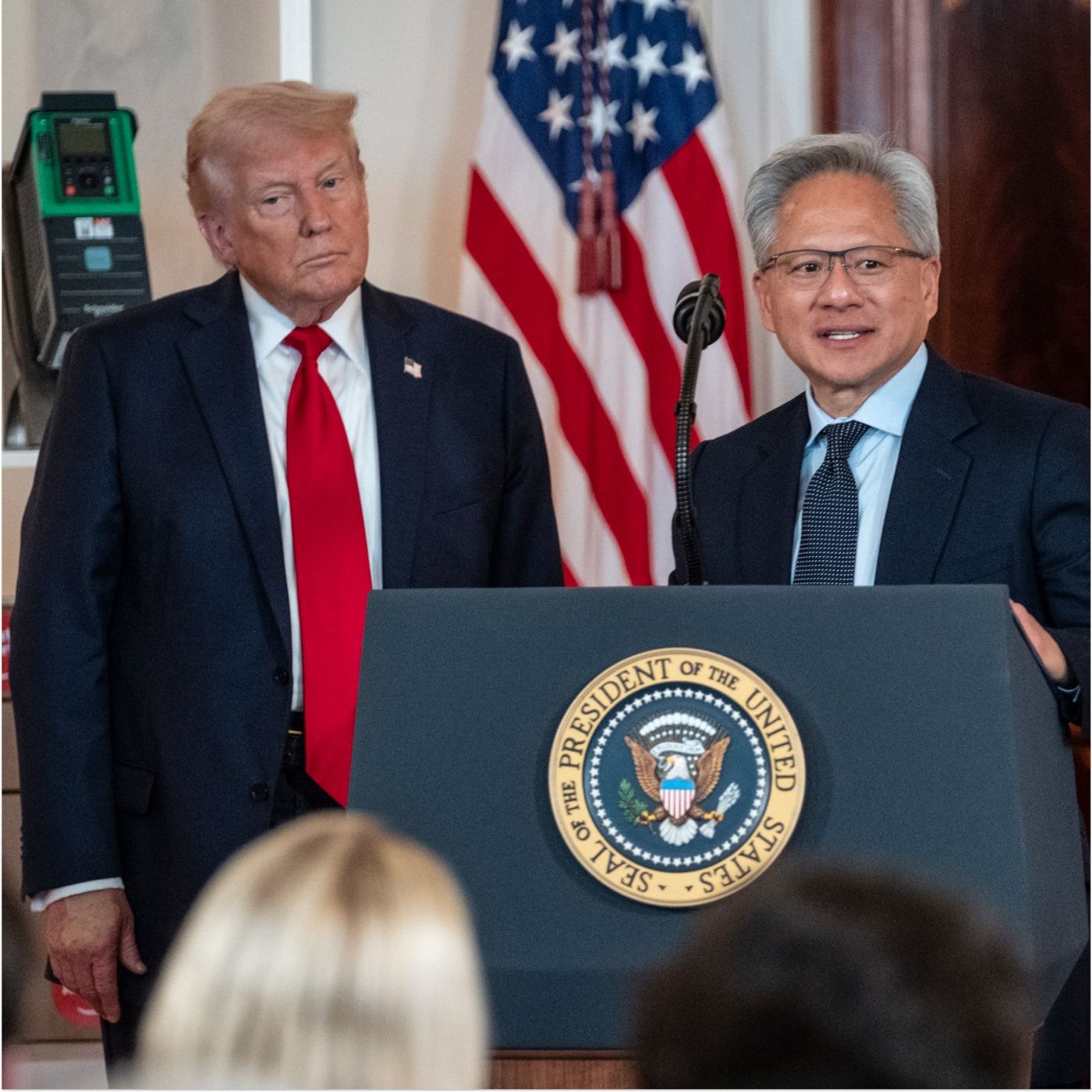
This episode explores the surprising reversal by President Trump to allow Nvidia, the leading AI chipmaker, to sell its advanced chips to China. The discussion delves into the lobbying efforts of Nvidia's CEO, Jensen Huang, the strategic arguments presented to the administration, and the broader implications for U.S.-China relations in the race for AI dominance.
Notable Quotes
- The best way for American companies in the AI world to succeed is to get as much of their technology around the world as fast as possible.
– Tripp Mickle, on Nvidia's strategy to maintain global dominance.
- If we don't sell to China, we're just leaving money on the table, and the Chinese are going to leapfrog us.
– Tripp Mickle, summarizing Nvidia's argument to the Trump administration.
- Trump loves winning, and he loves winners. And all of a sudden, he recognizes Jensen Huang as a U.S. winner.
– Tripp Mickle, on how Nvidia's CEO gained Trump's favor.
🧠 The Role of Nvidia in AI Dominance
- Nvidia holds a 90% market share in AI chip production, thanks to its early investment in the technology.
- The company’s chips are critical for developing AI systems, making it a linchpin in the global AI race.
- Nvidia's CEO, Jensen Huang, transitioned the company from gaming chips to AI dominance by investing billions in software and hardware innovation.
🤝 Lobbying and Trump’s Reversal
- Jensen Huang, despite his aversion to politics, engaged in lobbying efforts to reverse the U.S. ban on AI chip sales to China.
- Nvidia aligned with David Sachs, the White House AI advisor, who argued that selling chips globally would cement U.S. technological dominance.
- Trump’s decision was influenced by Nvidia’s promise to invest $500 billion in U.S. manufacturing and a major AI chip deal with the UAE, which aligned with his deals-first
approach.
🌍 The Paradox of Selling to China
- Nvidia argued that selling chips to China would prevent Huawei, China’s tech giant, from developing competitive alternatives.
- The strategy mirrors a NASCAR engine
analogy: selling technology to competitors generates revenue for further innovation but carries risks of being outpaced.
- Critics within the administration warned of national security risks, as AI chips could enhance China’s military capabilities.
💼 Economic vs. National Security Interests
- The Trump administration faced a tension between Silicon Valley’s push for global market access and national security concerns about empowering China.
- Nvidia emphasized that restricting sales would allow China to develop its own chips, potentially leapfrogging U.S. technology.
- The decision reflects a broader gamble on U.S. ingenuity and market dominance to stay ahead of China in AI.
👨💻 The Talent Arms Race
- China accounts for 50% of the world’s AI developers, making it a critical market for Nvidia.
- The U.S. and China are deeply intertwined in AI development, with American companies relying on Chinese talent and markets.
- The episode highlights the broader stakes of the AI race, where economic opportunities and national security concerns collide.
AI-generated content may not be accurate or complete and should not be relied upon as a sole source of truth.
📋 Episode Description
In the global fight to dominate A.I., China is quickly catching up to the United States — which is why President Trump barred the tech giant Nvidia from selling its superpowered computer chips to Chinese companies.
Then, a few days ago, Mr. Trump abruptly changed course.
Tripp Mickle, who covers Silicon Valley for The New York Times, explains how Nvidia’s C.E.O. persuaded the president that the best way to beat China at A.I. is to help them compete.
Guest: Tripp Mickle, who reports about Silicon Valley for The New York Times.
Background reading:
- Nvidia said that the U.S. had lifted restrictions on A.I. chip sales to China.
- How Nvidia’s Jensen Huang persuaded Mr. Trump to sell A.I. chips to China.
For more information on today’s episode, visit nytimes.com/thedaily. Transcripts of each episode will be made available by the next workday.
Photo: Pete Marovich for The New York Times
Unlock full access to New York Times podcasts and explore everything from politics to pop culture. Subscribe today at nytimes.com/podcasts or on Apple Podcasts and Spotify.