
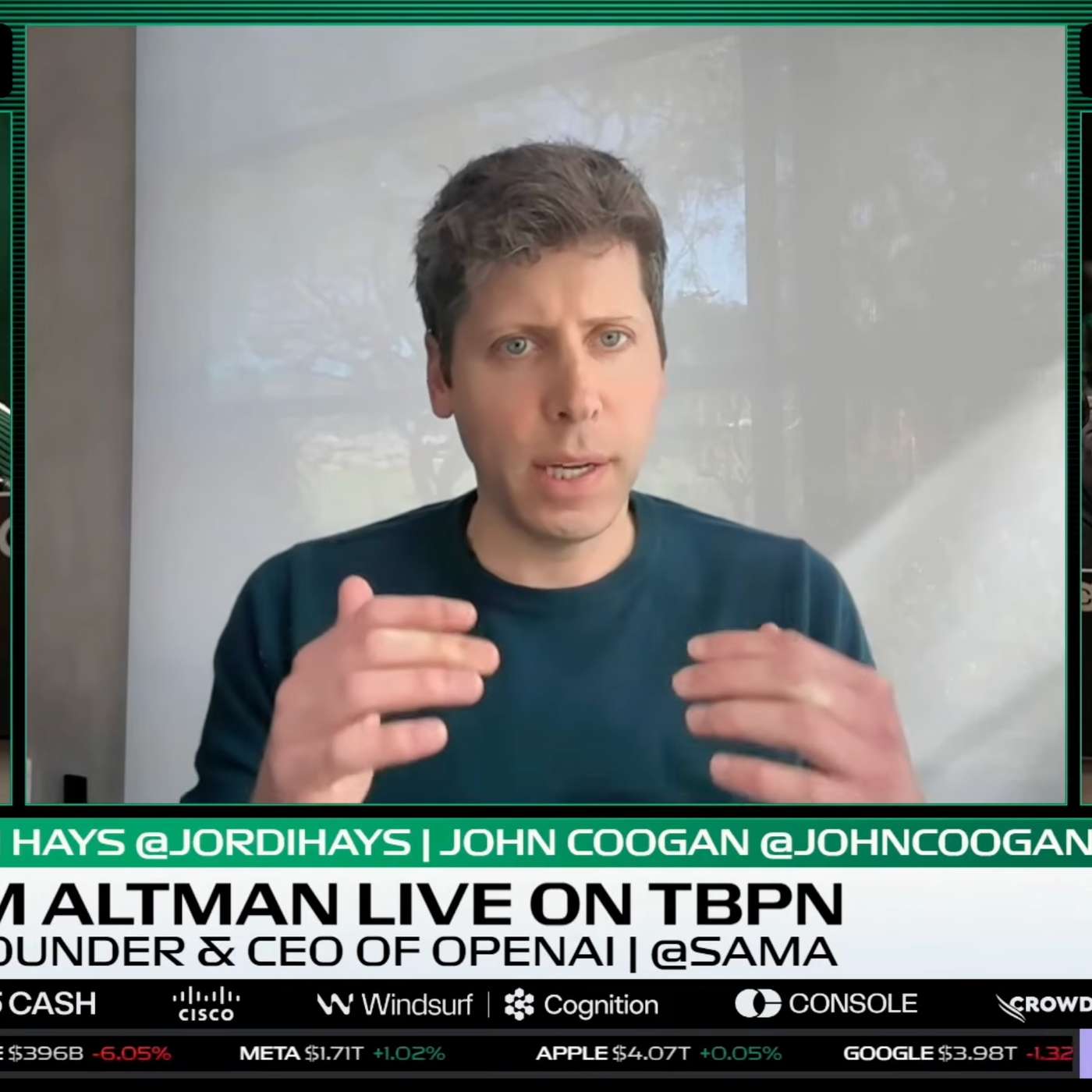
FULL INTERVIEW: Sam Altman Responds to Anthropic’s Attack Ads, Live on TBPN

🤖 AI Summary
Overview
This episode features Sam Altman, CEO of OpenAI, discussing the launch of Codex 5.3, the evolution of AI agent orchestration, the future of AI-powered workflows, and the challenges of scaling AI infrastructure. He also addresses Anthropic's Super Bowl ads and broader industry dynamics.
Notable Quotes
- Every company is an API company now, whether they want to be or not.
– Sam Altman, on the transformative impact of AI agents on businesses.
- The amazing capabilities of these models, the product, the groundswell of excitement around Codex—that feels way more important to me.
– Sam Altman, on staying focused amidst industry competition and media narratives.
- AI is now unbelievably capable, and most of the world is still asking it basic questions on ChatGPT.
– Sam Altman, on the untapped potential of AI tools.
🚀 Codex 5.3 and AI Agent Orchestration
- OpenAI launched Codex 5.3, described as the best coding model yet, with improved speed, smarter programming capabilities, and a more interactive user experience.
- The model allows for mid-task interaction, enabling users to steer workflows dynamically, which Altman likened to managing a team of agents.
- Codex 5.3 is part of a broader shift toward AI-powered workflows, where users manage increasingly complex tasks at higher levels of abstraction.
🧠 The Future of AI Workflows and Tools
- Altman predicts a future where individuals manage teams of AI agents, with tools evolving to simplify complex workflows.
- He emphasized the importance of reducing the capability overhang
by teaching users how to fully leverage AI tools.
- Codex Desktop has been a surprise hit, enabling even lightly technical users to engage in coding and general-purpose tasks. Plans include mobile integration for seamless task management.
💻 Industry Dynamics and AI Integration
- Altman discussed the role of forward-deployed engineers in helping non-AI-native companies integrate AI into their systems, focusing on security, orchestration, and fine-tuning.
- He highlighted the growing trend of hybrid research labs and product companies, which combine cutting-edge research with practical applications.
- On Anthropic's Super Bowl ads critiquing OpenAI, Altman dismissed them as a sideshow,
emphasizing OpenAI's focus on product innovation and user trust.
🔋 Scaling AI: Chips, Compute, and Bottlenecks
- Altman identified chips as the current bottleneck in scaling AI, though energy constraints also play a role. He advocated for societal investment in increasing global wafer capacity.
- He dismissed the near-term feasibility of space-based data centers but acknowledged the long-term potential.
- On the question of AI's upper limits, Altman admitted uncertainty but noted the profound implications of models capable of reasoning over extended time horizons.
🎥 AI in Media and Social Applications
- Altman discussed the potential of AI in video generation, including tools like Sora, which could revolutionize motion graphics and video editing.
- He expressed interest in reimagining social platforms where agents interact on behalf of users, though he acknowledged the challenges of bot-driven engagement on existing platforms.
- Personalized media, such as AI-generated caricatures and memes, has emerged as a popular use case, blending creativity with user identity.
AI-generated content may not be accurate or complete and should not be relied upon as a sole source of truth.
📋 Episode Description
This is our full interview with OpenAI CEO Sam Altman, recorded live on TBPN.
We discuss Anthropic's Super Bowl ads, Codex 5.3, why managing AI agents is the next interface shift, and how chips, power, and compute bottlenecks will shape the future of AI.
TBPN is a live tech talk show hosted by John Coogan and Jordi Hays, streaming weekdays from 11–2 PT on X and YouTube, with full episodes posted to podcast platforms immediately after.
Described by The New York Times as “Silicon Valley’s newest obsession,” TBPN has recently featured Mark Zuckerberg, Sam Altman, Mark Cuban, and Satya Nadella.