

🤖 AI Summary
Overview
This episode delves into the Supreme Court's historic hearing on President Trump's executive order to limit birthright citizenship, a cornerstone of the 14th Amendment. The discussion explores the legal arguments presented by both sides, the justices' reactions, and the broader implications for immigration policy and constitutional interpretation. Notably, President Trump attended the hearing, underscoring the case's significance to his administration.
Notable Quotes
- You all want to sit in judgment of my executive order on birthright citizenship. Therefore, I'm going to sit in judgment of you as you do that.
— Michael Barbaro, on the symbolism of Trump's presence in the courtroom.
- Unrestricted birthright citizenship demeans the priceless and profound gift of American citizenship.
— John Sauer, Solicitor General, arguing for the administration's position.
- Even in wartime, this principle was affirmed over and over again throughout history.
— Cecilia Wong, ACLU lawyer, defending the broad interpretation of the 14th Amendment.
🛑 The Stakes of Birthright Citizenship
- The case centers on President Trump's executive order to exclude children of undocumented immigrants and temporary visitors from birthright citizenship, challenging the long-standing interpretation of the 14th Amendment.
- Ann E. Marimow highlights the historic nature of the hearing, with Trump being the first sitting president to attend a Supreme Court oral argument.
- The administration's argument hinges on the phrase subject to the jurisdiction thereof,
claiming it excludes children of undocumented immigrants.
⚖️ Legal Arguments and Historical Precedents
- Solicitor General John Sauer argued that the 14th Amendment's original intent was limited to children of legally domiciled individuals, citing the 1898 Wong Kim Ark case.
- The administration emphasized domicile
and allegiance
as critical factors, asserting that undocumented immigrants cannot legally establish domicile or full allegiance to the U.S.
- Justices, including conservatives like Chief Justice Roberts and Justice Gorsuch, expressed skepticism, questioning the administration's reliance on historical interpretations and the practicality of its arguments.
📜 The ACLU's Defense of Birthright Citizenship
- Cecilia Wong of the ACLU argued that the 14th Amendment guarantees citizenship to anyone born on U.S. soil, regardless of their parents' status.
- She dismissed the administration's focus on domicile
as irrelevant, pointing out that Wong Kim Ark affirmed a broad principle of birthright citizenship.
- Wong cited historical examples, including children of Japanese nationals interned during WWII, to demonstrate the enduring application of this principle.
🤔 Judicial Reactions and Key Moments
- Chief Justice Roberts referred to the administration's theory as quirky,
questioning its expansion of exceptions to birthright citizenship.
- Justice Kagan and Justice Gorsuch challenged the administration's reliance on obscure historical sources and the absence of domicile
in the 14th Amendment debates.
- Justice Alito raised hypotheticals about dual allegiances, but Wong countered by emphasizing the focus on children born in the U.S., not their parents' status.
🏛️ The Symbolism of Trump's Presence
- Trump's attendance was seen as a strategic move to underscore the importance of the case to his administration's immigration agenda.
- He left midway through the hearing, later criticizing birthright citizenship on social media, calling the U.S. stupid enough
to allow it—a claim factually incorrect, as many countries have similar policies.
- Michael Barbaro noted that Trump's departure and subsequent comments suggested uncertainty about the case's outcome.
AI-generated content may not be accurate or complete and should not be relied upon as a sole source of truth.
📋 Episode Description
The Supreme Court heard arguments on Wednesday morning over President Trump’s efforts to limit birthright citizenship. In a historic first, the president himself showed up to the hearing.
Ann E. Marimow, who covers the Supreme Court, took us inside the room.
Guest: Ann E. Marimow covers the Supreme Court for The New York Times from Washington.
Background reading:
- Here are five takeaways from the birthright citizenship argument.
- Mr. Trump attended the Supreme Court oral arguments, then left an hour in.
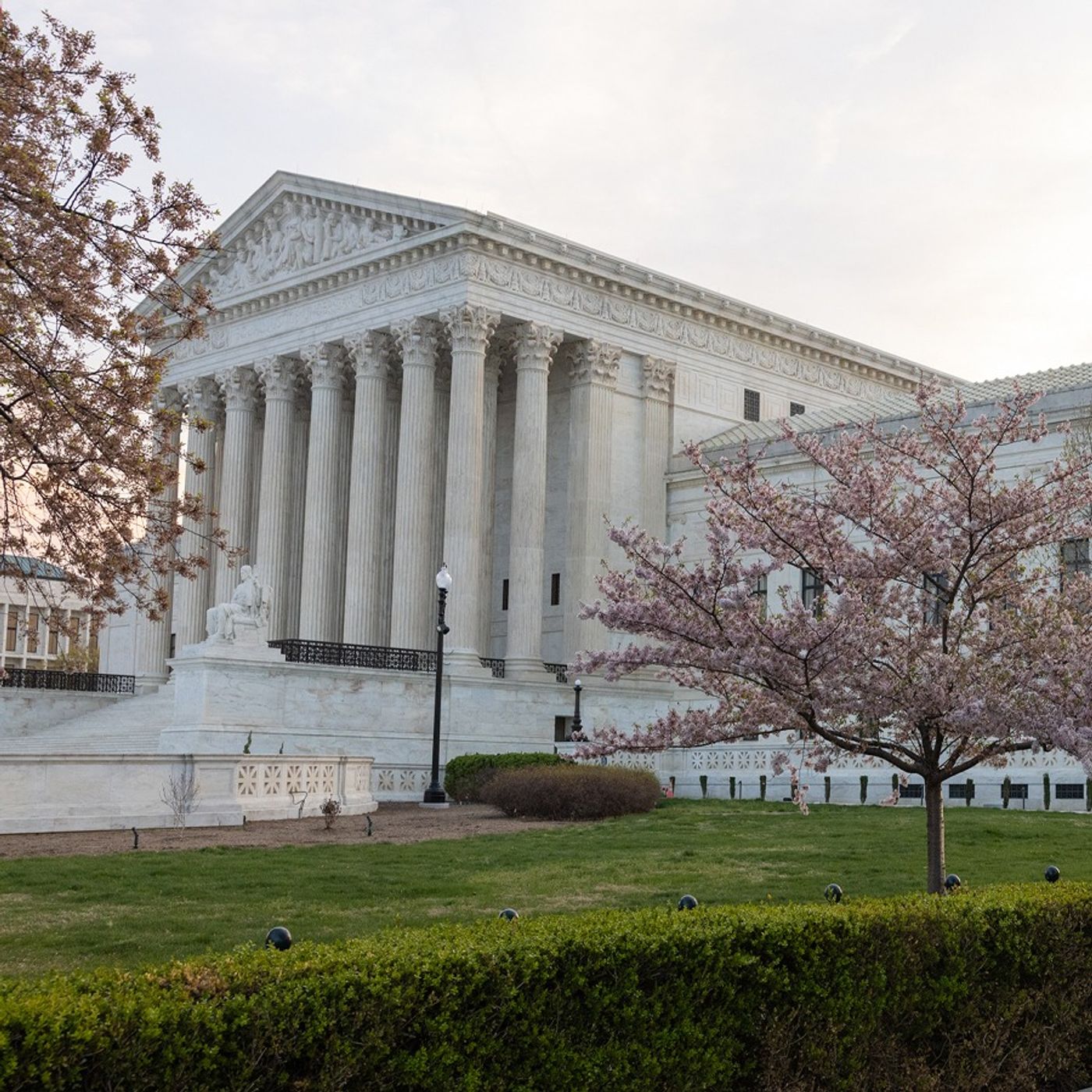
Photo: Anna Rose Layden for The New York Times
For more information on today’s episode, visit nytimes.com/thedaily. Transcripts of each episode will be made available by the next workday.
Subscribe today at nytimes.com/podcasts or on Apple Podcasts and Spotify. You can also subscribe via your favorite podcast app here https://www.nytimes.com/activate-access/audio?source=podcatcher. For more podcasts and narrated articles, download The New York Times app at nytimes.com/app.
Hosted by Simplecast, an AdsWizz company. See pcm.adswizz.com for information about our collection and use of personal data for advertising.