

🤖 AI Summary
Overview
This episode dives deep into the inner workings of AI chips, starting from fundamental logic gates and building up to complex architectures like GPUs, TPUs, and FPGAs. Reiner Pope, CEO of MadX, explains the trade-offs in chip design, the principles behind systolic arrays, and how modern chips balance compute and communication. The discussion also explores comparisons between chips and the human brain, as well as the differences between GPUs and TPUs.
Notable Quotes
- Almost all of the cost in a chip is in moving data, not in the computation itself.
– Reiner Pope, on the hidden costs of data movement in chip design.
- A GPU is just a bunch of tiny TPUs tiled across the chip.
– Reiner Pope, explaining the structural differences between GPUs and TPUs.
- The brain runs at a much slower clock speed, but it’s optimized for energy efficiency in a way silicon chips aren’t.
– Reiner Pope, on the differences between biological and silicon computation.
🧮 Building Blocks of AI Chips
- Chips are built from basic logic gates (AND, OR, NOT) connected by physical wires. These gates perform fundamental operations like multiply-accumulate (MAC), which is central to AI computations.
- AI chips prioritize matrix multiplication, as it underpins neural network operations. Multiply-accumulate circuits are optimized for low precision (e.g., 4-bit multiplication with 8-bit accumulation) to balance efficiency and error accumulation.
- Precision scaling is quadratic in cost, making lower precision arithmetic highly favorable for neural networks.
🔀 Muxes and Data Movement Costs
- Muxes (multiplexers) are used to select inputs in chip operations, but their cost scales with the number of inputs and bits. For example, an 8-input mux requires significant logic gates, adding to the chip's complexity.
- Data movement, such as transferring values between registers and logic units, is often more expensive than the computation itself. This inefficiency drives innovations like systolic arrays to minimize communication overhead.
- GPUs and TPUs differ in how they handle data movement, with GPUs offering more flexibility but at higher communication costs.
📐 Systolic Arrays and Matrix Multiplication
- Systolic arrays are specialized hardware for matrix multiplication, where data flows through a grid of processing elements. This minimizes data movement by storing matrices locally and reusing them across computations.
- TPUs leverage large systolic arrays to maximize compute density, while GPUs use smaller, distributed systolic arrays within their cores.
- The design of systolic arrays balances compute and communication, with techniques like slow trickle-feeding of data to reduce bandwidth requirements.
⏱ Clock Cycles and Pipeline Optimization
- A chip’s clock cycle synchronizes operations across its components, but the speed is limited by the longest computation path.
- Pipeline registers are inserted to split long operations into smaller steps, enabling higher clock speeds. However, excessive pipelining can reduce throughput by increasing synchronization overhead.
- Deterministic latency, crucial for applications like high-frequency trading, can be achieved by simplifying chip designs and avoiding features like caches that introduce variability.
🧠 Chips vs. the Human Brain
- Unlike chips, the brain operates with unstructured sparsity, where any neuron can connect to any other. Chips, in contrast, rely on structured sparsity for efficiency.
- The brain’s slower clock speed
is an energy-saving feature, as faster switching in chips requires higher voltages and more energy.
- Memory and compute are co-located in the brain, similar to how systolic arrays store data locally to reduce movement costs. However, the brain’s architecture is far more flexible and adaptive.
AI-generated content may not be accurate or complete and should not be relied upon as a sole source of truth.
📋 Episode Description
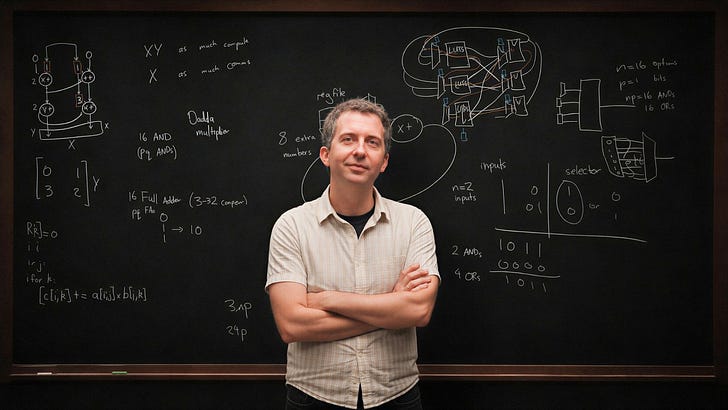
New blackboard lecture with Reiner Pope: how do chips actually work - starting with basic logic gates, and working up to why GPUs, TPUs, FPGAs, and the human brain each look the way they do.
Reiner is CEO of MatX, a new chip startup (full disclosure - I’m an angel investor). He was previously at Google, where he worked on software efficiency, compilers, and TPU architecture.
Watch this one on YouTube so you can see the chalkboard. Read the transcript.
Sponsors
* Crusoe was one of only five GPU clouds that made the gold tier in SemiAnalysis' most recent ClusterMAX report. Gold-tier providers like Crusoe delivered 5-15% lower TCO than silver-tier clouds, even with identical GPU pricing. This is because optimizations like early fault detection and rapid node replacement don't necessarily show up in the sticker price, but still matter a ton in the real world. Learn more at crusoe.ai/dwarkesh
* Cursor is where I do most of my work—from reading research papers to visualizing technical concepts to coding up internal tools for the podcast. Most recently, I used it to build two different review interfaces for my essay contest, one that anonymizes submissions for scoring and another that lets me see applicants' essays next to their resumes and websites. Whatever you're working on, you should try doing it in Cursor. Get started at cursor.com/dwarkesh
* Jane Street let me ask Ron Minsky and Dan Pontecorvo, two senior Jane Streeters, a bunch of questions about how they use AI. We discussed everything from the types of models they're training to how they think about the future of trading to why they're more bullish than ever on hiring technical talent. You can watch the full conversation and learn more about their open positions at janestreet.com/dwarkesh
Timestamps
00:00:00 – Building a multiply-accumulate from logic gates
00:16:31 – Muxes and the cost of data movement
00:26:10 – How systolic arrays work
00:39:11 – Clock cycles and pipeline registers
00:51:51 – FPGAs vs ASICs
01:03:25 – Cache vs scratchpad
01:07:27 – Why CPU cores are much bigger than GPU cores
01:12:00 – Brains vs chips
01:15:33 – A GPU is just a bunch of tiny TPUs
Get full access