
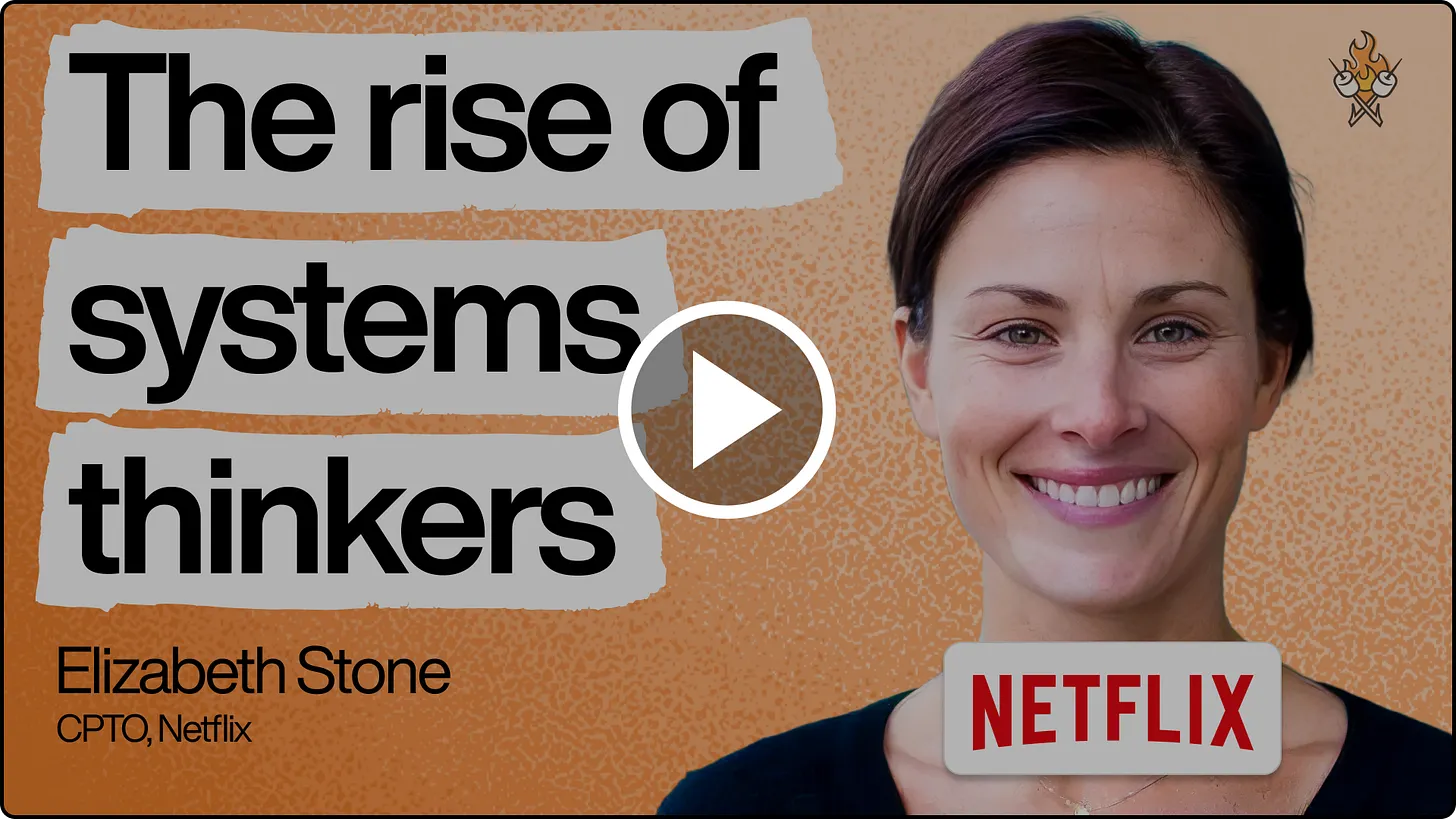
Netflix CPTO on AI and the future of product and tech roles | Elizabeth Stone

🤖 AI Summary
Overview
This episode features Elizabeth Stone, Chief Product and Technology Officer at Netflix, discussing the transformative impact of AI on product and tech roles, the importance of systems thinking, and how Netflix maintains its culture of excellence. The conversation explores how AI is reshaping workflows, the evolving nature of roles in tech, and the future of entertainment.
Notable Quotes
- Excellence as an operating system—when you have great talent and give them the ability to do their best work without micromanaging or drowning them in process, you get much better outcomes.
– Elizabeth Stone, on Netflix’s cultural philosophy.
- The days of very narrow, deep specialization feel more limited to me. We need fewer specialists and more people who are generalists or adaptable in multiple directions.
– Elizabeth Stone, on the evolving skillsets in tech.
- Storytelling is one and the same with humanity. I have a hard time picturing entertainment that doesn’t have humans at the heart of it.
– Elizabeth Stone, on the role of humans in the future of AI-driven entertainment.
🎭 The Role of AI in Transforming Job Functions
- AI is enabling professionals to cross traditional boundaries: PMs can write code, designers can draft PRDs, and engineers can contribute to product strategy.
- This fluidity is creating confusion about roles, but Elizabeth emphasizes that functional expertise remains critical.
- Netflix is addressing this by implementing guardrails, ensuring clarity on data sources, and emphasizing human accountability for AI-generated outputs.
🧠 Systems Thinking as a Critical Skill
- Elizabeth highlights systems thinking as the most important skill for navigating the complexities of AI-driven workflows.
- She advises stepping back to question assumptions and consider the broader context of any problem.
- Netflix is hiring more systems thinkers across functions, from engineering to design, to create scalable, coherent solutions.
🎨 AI’s Role in Creativity and Entertainment
- Netflix uses AI for content production, localization, promotional assets, and even creative ideation.
- The company acquired Interpositive, a startup that uses AI for post-production tasks like relighting and reframing scenes.
- While AI is a powerful tool, Elizabeth believes humans will remain central to storytelling and creative processes.
🏆 Excellence as an Operating System
- Netflix’s culture is built on excellence as an operating system,
which includes high talent density, autonomy, and a focus on outcomes over process.
- The company emphasizes risk-taking, learning from failures, and avoiding unnecessary processes that stifle innovation.
- The Keeper Test
remains a cornerstone of Netflix’s culture, ensuring only top talent stays while fostering open feedback and growth.
📺 The Future of Entertainment
- Netflix is expanding beyond traditional film and TV to include games, live content, and podcasts, aiming to create a seamless, personalized entertainment experience.
- AI is central to this evolution, helping with discovery, content creation, and localization.
- Elizabeth envisions a future where entertainment is more immersive, interactive, and diverse, but always with humans at the heart of storytelling.
AI-generated content may not be accurate or complete and should not be relied upon as a sole source of truth.
📋 Episode Description
Elizabeth Stone is the Chief Product and Technology Officer (CPTO) at Netflix, where she oversees Engineering, Product, and Design. Since her first appearance on the podcast two years ago—which remained my second-most-popular episode for more than a year—she has expanded her role to lead product, in addition to engineering. Before Netflix, Elizabeth was VP of Science at Lyft, Chief Operating Officer at Nuna, an economist at Analysis Group, and a trader at Merrill Lynch.
In our in-depth conversation, we discuss:
1. Why “systems thinking” is now the most important skill she looks for
2. How to manage the flood of AI-generated output without losing quality or signal
3. How Netflix thinks about AI fluency as a universal expectation rather than a level-specific skill
4. What “excellence as an operating system” means
—
Brought to you by:
WorkOS—Make your app enterprise-ready, with SSO, SCIM, RBAC, and more: https://workos.com/lenny
Mercury—Radically different banking, now with Command: https://mercury.com/command?utm_source=lennys&utm_medium=sponsored_newsletter&utm_campaign=26q3_brand_campaign
—
Episode transcript: https://www.lennysnewsletter.com/p/netflix-cpto-on-ai-and-the-future
—
Archive of all Lenny's Podcast transcripts: https://www.dropbox.com/scl/fo/yxi4s2w998p1gvtpu4193/AMdNPR8AOw0lMklwtnC0TrQ?rlkey=j06x0nipoti519e0xgm23zsn9&st=ahz0fj11&dl=0
—
Where to find Elizabeth Stone:
• LinkedIn: https://www.linkedin.com/in/elizabeth-stone-608a754
—
Where to find Lenny:
• Newsletter: https://www.lennysnewsletter.com
• X: https://twitter.com/lennysan
• LinkedIn: https://www.linkedin.com/in/lennyrachitsky/
—
In this episode, we cover:
(00:00) Introduction
(02:25) AI and role confusion: the storming phase before the forming