

🤖 AI Summary
Overview
This episode delves into the audacious heist at the Louvre Museum in Paris, where thieves stole priceless French crown jewels in broad daylight. Catherine Porter, a New York Times international correspondent based in Paris, provides a detailed account of how the robbery unfolded, the cultural significance of the stolen items, and the ongoing investigation.
Notable Quotes
- This is the heist of the decade, you know. It's as bad as it gets.
- Natalie Kitroeff, on the audacity of the Louvre robbery.
- France doesn't actually have a huge amount of royal jewels like this because of the revolution.
- Catherine Porter, explaining the historical rarity of the stolen items.
- I think it's possible that we will never see those jewels again.
- Catherine Porter, on the likelihood of recovering the stolen treasures.
🪜 The Heist: A Step-by-Step Breakdown
- The robbery began at 9:30 a.m. on a quiet Sunday morning in Paris.
- Thieves arrived in a truck with a ladder and two motorcycles, disguised as public workers with fluorescent vests.
- Using an electric ladder and angle grinders, they broke into the Apollo Gallery, home to France's royal jewels.
- Security guards followed protocol by evacuating visitors instead of confronting the thieves.
- The thieves escaped within minutes, leaving behind a stolen truck and fleeing on motorcycles.
💎 The Stolen Crown Jewels
- The thieves targeted specific items, including an emerald necklace and earring set gifted by Napoleon to his second wife, and a diamond bow worn by Empress Eugenie.
- They avoided the most expensive and identifiable item, the Regent diamond, likely due to its high profile and difficulty to sell.
- Experts suggest the stolen items may be disassembled and sold as individual components to avoid detection.
🇫🇷 France's Emotional Reaction
- The heist has sparked shock, anger, and grief among the French public, who view the stolen jewels as priceless cultural heritage.
- The incident has led to self-questioning about security measures at the Louvre, with some blaming the government for underfunding museum protection.
- The theft is seen as a symbolic loss, akin to the emotional response to the Notre Dame fire.
🕵️♂️ The Investigation and Broader Context
- Over 100 investigators are working on the case, using DNA, fingerprints, and surveillance footage.
- The stolen truck, left behind by the thieves, is a key piece of evidence.
- The heist is part of a recent string of museum robberies in France, raising concerns about organized crime targeting cultural institutions.
- While France has a strong record of recovering stolen artifacts, experts fear the jewels may be irreparably dismantled and lost forever.
AI-generated content may not be accurate or complete and should not be relied upon as a sole source of truth.
📋 Episode Description
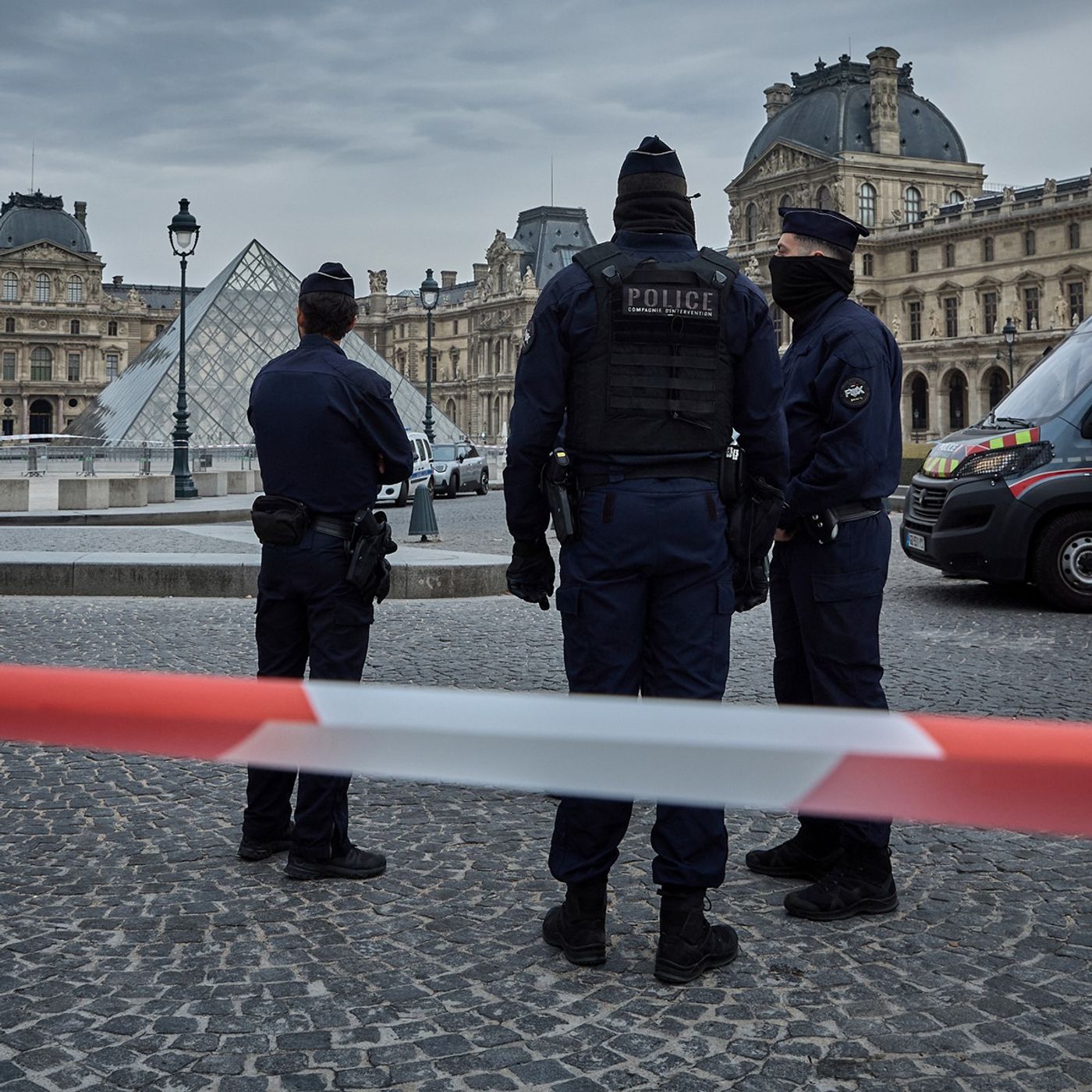
In just under 10 minutes on Sunday, thieves stole precious jewelry from the Louvre Museum in Paris after using a truck-mounted ladder to break into a second-floor window.
Catherine Porter, a New York Times international correspondent in the French capital, explains how the robbery unfolded.
Guest: Catherine Porter, an international correspondent for The New York Times based in Paris.
Background reading:
- What we know about the Louvre jewelry theft.
- Before the robbery, there were lingering security concerns.
Photo: Kiran Ridley/Getty Images
For more information on today’s episode, visit nytimes.com/thedaily. Transcripts of each episode will be made available by the next workday.
Subscribe today at nytimes.com/podcasts or on Apple Podcasts and Spotify. You can also subscribe via your favorite podcast app here https://www.nytimes.com/activate-access/audio?source=podcatcher. For more podcasts and narrated articles, download The New York Times app at nytimes.com/app.