
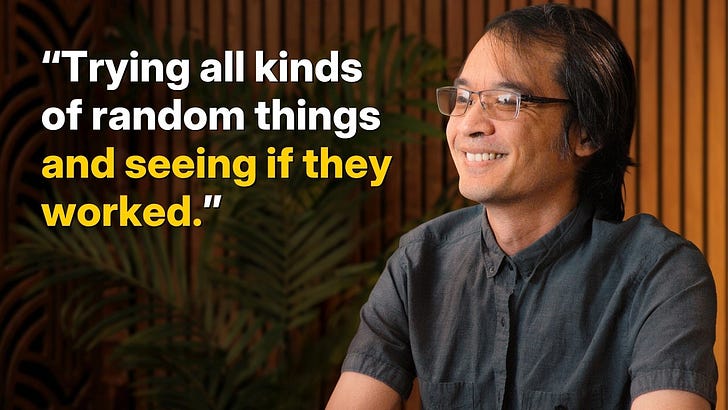
Terence Tao – Kepler, Newton, and the true nature of mathematical discovery

🤖 AI Summary
Overview
This episode explores the intersection of mathematics, artificial intelligence, and scientific discovery. Terence Tao discusses historical breakthroughs like Kepler's laws of planetary motion, the evolving role of AI in mathematics, and how AI might reshape the way we approach problems, generate insights, and collaborate in the future.
Notable Quotes
- AI has driven the cost of idea generation down to almost zero, but it doesn’t create abundance by itself.
– Terence Tao, on the shifting bottlenecks in scientific progress.
- The biggest advances often come not by adding more theories, but by deleting assumptions we’ve held for centuries.
– Terence Tao, on paradigm shifts in science.
- We need to redesign the way we do science to take full advantage of AI’s breadth capabilities.
– Terence Tao, on the complementary strengths of humans and AI.
🌌 Kepler’s Discovery and the Nature of Scientific Progress
- Terence Tao recounts how Kepler, using Tycho Brahe’s precise astronomical data, discovered the laws of planetary motion. Kepler’s process involved trial, error, and abandoning his initial theory of Platonic solids.
- This story illustrates how scientific progress often requires judgment, heuristics, and decades of verification, which AI might struggle to replicate.
- Dwarkesh Patel draws an analogy between Kepler’s iterative approach and how large language models (LLMs) explore random relationships to uncover patterns.
🤖 AI’s Role in Mathematics and Science
- AI excels at breadth, rapidly testing existing techniques across many problems, while humans excel at depth and cumulative understanding.
- Tao notes that AI has solved 50 previously unsolved problems in the Erdos problem set but struggles with generating partial progress or intermediate insights.
- The current bottleneck in science is not idea generation but verification and evaluation, as AI floods the field with potential solutions.
📊 The Deductive Overhang and Experimental Math
- Tao highlights the deductive overhang
in mathematics: many problems could be solved by systematically applying known techniques, but this has been underexplored.
- AI could revolutionize experimental mathematics by analyzing large datasets, testing hypotheses at scale, and identifying patterns humans might miss.
- However, Tao warns that AI’s success rate on unsolved problems is still low (~1-2%), and its contributions often rely on brute force rather than conceptual breakthroughs.
🧠 Understanding AI-Generated Proofs
- If AI solves a major problem like the Riemann Hypothesis, Tao believes humans could still extract understanding by analyzing the proof’s structure and key steps.
- Tools like Lean (a formal proof assistant) enable mathematicians to deconstruct and refine AI-generated proofs, potentially uncovering new mathematical insights.
- Tao suggests developing a semi-formal language to capture the way scientists discuss strategies and conjectures, bridging the gap between intuition and formal logic.
🌍 The Future of Math and AI Collaboration
- Hybrid human-AI collaboration will dominate mathematics for the foreseeable future, with AI handling breadth and humans focusing on depth.
- Tao predicts that AI will make math papers richer and broader by automating secondary tasks like visualization and literature reviews, but the core creative process remains human-driven.
- He emphasizes the importance of serendipity and adaptability in research, warning against over-optimization that might stifle unexpected discoveries.
AI-generated content may not be accurate or complete and should not be relied upon as a sole source of truth.
📋 Episode Description
We begin the episode with the absolutely ingenious and surprising way in which Kepler discovered the laws of planetary motion.
People sometimes say that AI will make especially fast progress at scientific discovery because of tight verification loops.
But the story of how we discovered the shape of our solar system shows how the verification loop for correct ideas can be decades (or even millennia) long.
During this time, what we know today as the better theory can actually make worse predictions.
And the reasons it survives this epistemic hell is some mixture of judgment and heuristics that we don’t even understand well enough to actually articulate, much less codify into an RL loop. Hope you enjoy!
Watch on YouTube; read the transcript.
Sponsors
- Jane Street loves challenging my audience with different creative puzzles. One of my listeners, Shawn, solved Jane Street’s ResNet challenge and posted a great walk-through on X. If you want to try one of these puzzles yourself, there’s one live now at janestreet.com/dwarkesh.
- Labelbox can get you rubric-based evals, no matter your domain. These rubrics allow you to give your model feedback on all the dimensions you care about, so you can train how it thinks, not just what it thinks. Whatever you’re focused on—math, physics, finance, psychology or something else—Labelbox can help. Learn more at labelbox.com/dwarkesh.
- Mercury just released a new feature called Insights. Insights summarizes your money in and out, showing you your biggest transactions and calling out anything worth paying attention to. It’s a super low-friction way to stay on top of your business. Learn more at mercury.com/insights.
Timestamps
(00:00:00) – Kepler was a high temperature LLM
(00:11:44) – How would we know if there’s a new unifying concept within heaps of AI slop?
(00:26:10) – The deductive overhang
(00:30:31) – Selection bias in reported AI discoveries
(00:46:43) – AI makes papers richer and broader, but not deeper
(00:53:00) – If AI solves a problem, can humans get understanding out of it?
(00:59:20) – We need a semi-formal language for the way that scientists actually talk to each other
(01:09:48) – How Terry uses his time
(01:17:05) – Human-AI hybrids will dominate math for a lot longer
Get full access