

🤖 AI Summary
Overview
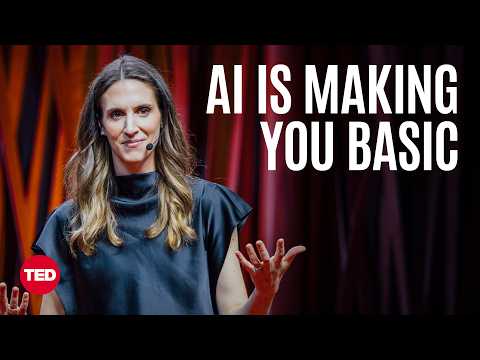
Sandra Matz explores how AI, while simplifying decision-making, risks homogenizing human experiences and preferences. She delves into the tension between exploitation (sticking to the familiar) and exploration (venturing into the unknown), arguing that AI's tendency to prioritize safe, predictable choices could erode individuality and creativity. Matz proposes actionable ways to reclaim human complexity and curiosity in an AI-driven world.
Notable Quotes
- I worry that AI will make us boring. The more we outsource our decisions to AI, the more we surrender something deeply human—our capacity to explore, to take risks, to stumble into the unknown, and sometimes surprise even ourselves.
– Sandra Matz
- AI turns this infinite diversity of human opinions, beliefs, and preferences into statistically safe sameness.
– Sandra Matz
- Next time AI offers you pralines and cream, maybe say no and ask it to help you go wild and reckless instead.
– Sandra Matz
🧠 The Exploitation-Exploration Trade-Off
- Matz introduces the concept of the exploitation-exploration trade-off, a dilemma humans face when choosing between familiar, safe options (exploitation) and risky, novel ones (exploration).
- Evolution hardwired humans to balance these instincts for survival, but modern AI systems overwhelmingly favor exploitation, optimizing for short-term satisfaction and engagement.
- Examples include AI-driven platforms like Spotify and Netflix, which prioritize recommendations based on past preferences rather than encouraging discovery.
🍦 AI’s Role in Flattening Human Preferences
- Matz illustrates AI’s narrowing effect through a Baskin-Robbins analogy: when asked to recommend ice cream flavors, ChatGPT overwhelmingly suggested the two most popular options, ignoring the diversity of choices.
- Studies show that AI-guided decisions lead to more normative preferences, less creative output, and homogenized opinions about cultural icons and interests.
- This death by a thousand algorithmic recommendations
subtly erodes individuality, turning people into less dynamic, more predictable versions of themselves.
📉 The Existential Cost of AI’s Safe Bets
- AI’s preference for safe, predictable outcomes stems from its design to minimize risk and maximize user satisfaction. This approach reduces customer churn but comes at the cost of human complexity.
- Even when AI learns individual quirks, it still optimizes within narrow boundaries, reinforcing sameness rather than encouraging diversity.
- Matz warns that as AI increasingly acts on our behalf, this flattening effect could become existential, stripping away the contradictions and quirks that make us human.
🎛️ Reclaiming Curiosity with AI
- Matz proposes a solution: reprogramming AI to balance exploitation with exploration by rewarding it for taking smart risks.
- She envisions tools like a preference dial
on platforms like Netflix or Spotify, allowing users to adjust how much they want to explore beyond their usual preferences—from spot on
to wildcard.
- By leveraging AI’s ability to detect patterns in vast datasets, it could guide users toward curated, novel experiences that expand their horizons without overwhelming them.
🌟 Preserving Human Complexity in an AI World
- Matz emphasizes the importance of preserving the messy, unique aspects of humanity—our quirks, contradictions, and capacity for surprise.
- She calls for a cultural shift in how we design and interact with AI, urging companies to prioritize exploration and creativity alongside convenience.
- The ultimate goal is to ensure that AI enhances, rather than diminishes, what makes us human: our individuality, curiosity, and capacity for growth.
AI-generated content may not be accurate or complete and should not be relied upon as a sole source of truth.
📋 Video Description
When you need to make a decision, you might turn to AI for advice. But what happens when you let algorithms decide more and more things for you? Computational social scientist Sandra Matz reveals how AI models limit what you see, discover and try, subtly flattening what makes you unique. Hear her tips for how to use AI to fuel your curiosity and expand your world instead. (Recorded at TEDxNewEngland on October 30, 2025)
Join us in person at a TED conference: https://tedtalks.social/events
Become a TED Member to support our mission: https://ted.com/membership
Subscribe to a TED newsletter: https://ted.com/newsletters
Follow TED!
Instagram: https://www.instagram.com/ted
LinkedIn: https://www.linkedin.com/company/ted-conferences
TikTok: https://www.tiktok.com/@tedtoks
Facebook: https://facebook.com/TED
X: https://www.twitter.com/TEDTalks
The TED Talks channel features the best talks and performances from the TED Conference, where the world's leading thinkers and doers give the talk of their lives in 18 minutes (or less) — plus originals, podcasts and exclusive content. Look for videos on Technology, Entertainment and Design as well as science, business, global issues, the arts and more. Visit https://TED.com for our entire library, transcripts, translations and personalized recommendations.
Watch more: https://go.ted.com/sandramatz
https://youtu.be/9Ff4S1FJdRM
TED videos may be used for non-commercial purposes under a Creative Commons License, Attribution–Non Commercial–No Derivatives (or the CC BY – NC – ND 4.0 International) and in accordance with the TED Talks Usage Policy: https://www.ted.com/about/our-organization/our-policies-terms/ted-talks-usage-policy. For more information on using TED for commercial purposes (e.g. employee learning, in a film or online course), submit a request at https://media-requests.ted.com
#TED #TEDTalks #AI