
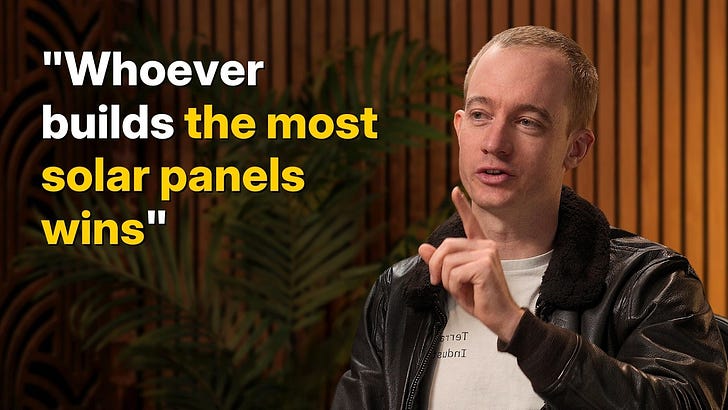
China is killing the US on energy. Does that mean they’ll win AGI? – Casey Handmer

🤖 AI Summary
Overview
This episode explores the intersection of AI, energy, and industrial strategy, with a focus on how the U.S. can compete with China in the race for energy dominance and AI development. Casey Handmer, founder of Terraform Industries, argues that solar energy will play a pivotal role in meeting the massive energy demands of AI, while also addressing regulatory, technological, and geopolitical challenges.
Notable Quotes
- The United States is the luckiest country on Earth because it's surrounded by oceans and allies, while China is surrounded by 15 mostly hostile neighbors.
– Casey Handmer, on geopolitical advantages.
- Solar adoption, production, and price decreases are not just continuing—they're accelerating, and the rate of acceleration is still accelerating.
– Casey Handmer, on solar energy's exponential growth.
- In the future, one human brain could be simulated by a square meter of silicon floating in space.
– Casey Handmer, envisioning the ultimate energy-cognition singularity.
🌍 Why China Doesn’t Automatically Win the AI-Energy Race
- Geopolitical constraints: Casey Handmer highlights China's vulnerabilities, including its reliance on Middle Eastern oil transported via insecure routes and its lack of natural geographic defenses.
- Capital allocation inefficiencies: Handmer argues that China's focus on projects like high-speed rail reflects poor capital allocation, whereas the U.S. has strengths in automation and financial capacity.
- Synthetic fuels: While Terraform Industries' synthetic fuel technology could benefit China, Handmer emphasizes that the U.S. still has the industrial and technological edge to compete.
🔋 Why Hyperscalers Still Choose Natural Gas Over Solar
- Short-term pragmatism: Companies like Meta and Microsoft prioritize natural gas for its immediate availability and ease of deployment, especially for large-scale data centers.
- Solar’s learning curve: Despite this, Handmer predicts that solar will dominate by 2030 due to its 43% learning rate—every doubling of production reduces costs by nearly half.
- Industrial bottlenecks: The real challenge lies in scaling up manufacturing for solar panels, batteries, and turbines to meet the exponential demand from AI.
☀️ Building 50,000-Acre Solar-Powered Data Centers
- Land requirements: A 5-gigawatt solar-powered data center would require approximately 50,000 acres of land, but Handmer dismisses concerns about land scarcity, citing vast unused areas in places like Texas and Nevada.
- Permitting challenges: Regulatory hurdles, especially environmental reviews, are a significant barrier to large-scale solar deployment. Handmer calls for categorical exemptions for solar projects to accelerate adoption.
- Cost breakdown: The cost of land and solar infrastructure is minimal compared to the cost of GPUs, making solar a viable long-term solution for hyperscalers.
⚡ Batteries as the New Grid
- Decentralized energy storage: Handmer argues that batteries will increasingly replace traditional grid infrastructure, performing temporal arbitrage
by storing and releasing energy as needed.
- Declining grid reliance: As battery technology improves, the average distance electricity travels will shrink, reducing dependence on aging and expensive grid systems.
- Scalability: The per capita allocation of batteries is expected to grow exponentially, enabling localized energy solutions for both residential and industrial needs.
🚀 The Energy Singularity and Post-Human Civilization
- Energy as the new GDP: Handmer suggests that in a future dominated by AI, the true measure of economic value will shift from GDP to total energy consumption.
- Silicon-based cognition: He envisions a future where solar-powered silicon wafers in space simulate human-level cognition, representing the ultimate efficiency in energy-to-thought conversion.
- Industrial acceleration: The AI revolution will drive unprecedented demand for energy, leading to a reimagining of industrial processes to maximize speed and scalability.
AI-generated content may not be accurate or complete and should not be relied upon as a sole source of truth.
📋 Episode Description
How will we feed the 100s of GWs of extra energy demand that AI will create over the next decade? On this episode, Casey Handmer (Caltech PhD, former NASA JPL, founder & CEO of Terraform Industries) walks me through how we can pull it off, and why he thinks a major part of this energy singularity will be powered by solar. His views are contrarian, but he came armed to defend them.
Watch on YouTube; listen on Apple Podcasts or Spotify.
Sponsors
* Lighthouse helps frontier technology companies like Cursor and Physical Intelligence navigate the U.S. immigration system and hire top talent from around the world. Lighthouse handles everything for you, maximizing the probability of visa approval while minimizing the work you have to do. Learn more at lighthousehq.com/employers
To sponsor a future episode, visit dwarkesh.com/advertise.
Timestamps
(00:00:00) – Why doesn’t China win by default
(00:08:28) – Why hyperscalers choose natural gas over solar
(00:18:01) – Solar's astonishing learning rates
(00:27:02) – How to build 50,000 acre solar-powered data centers
(00:40:24) – Environmental regulations blocking clean energy
(00:44:04) – Batteries replacing the grid
(00:49:14) – GDP is broken, AGI's true value must be measured in total energy use
(00:58:45) – Silicon wafers in space with one mind each
Get full access to Dwarkesh Podcast at www.dwarkesh.com/subscribe