
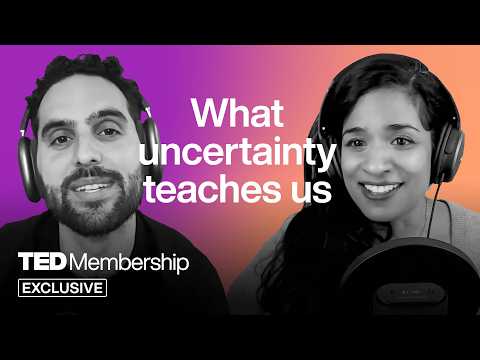
Why You Fear the Unknown — and What It Can Teach You | Maya Shankar and Simone Stolzoff | TED

🤖 AI Summary
Overview
This conversation between cognitive scientist Maya Shankar and author Simone Stolzoff explores why humans struggle with uncertainty and how embracing it can lead to growth, resilience, and new possibilities. Drawing on scientific studies, personal stories, and practical strategies, they discuss how to navigate life's unpredictable moments and reframe discomfort with the unknown into opportunities for transformation.
Notable Quotes
- When a big change happens to you, it also leads to lasting change within you.
– Maya Shankar, on the transformative potential of life’s challenges.
- You have to trust in your future self to handle your future problems.
– Simone Stolzoff, on managing anxiety about the unknown.
- Uncertainty doesn’t necessarily mean a threat. It can also be the birthplace of possibility.
– Simone Stolzoff, on reframing fear of the unknown.
🧠 The Psychology of Uncertainty
- Simone Stolzoff shares a study where participants were more anxious about a 50% chance of receiving an electric shock than a 100% certainty, highlighting how ambiguity amplifies stress.
- Maya Shankar explains that humans are prediction machines,
wired to seek certainty for survival, but this instinct can backfire in modern contexts.
- Waiting for outcomes, such as medical test results, often causes more stress than the outcomes themselves, as uncertainty creates a false sense of agency.
- The evolutionary roots of this discomfort are tied to survival instincts, but Shankar warns that intolerance for uncertainty can limit openness to new possibilities.
🪞 Identity and Change
- Shankar reflects on her career-ending injury as a violinist, which forced her to redefine her identity. She emphasizes anchoring identity to why you do something (e.g., human connection) rather than what you do.
- Stolzoff shares the story of a woman with a chronic illness who shifted her self-worth from external achievements to intrinsic traits like generosity and values.
- Both speakers advocate for diversifying identities and focusing on evergreen traits
that remain constant amidst change.
🌫️ Embracing the Fog of Uncertainty
- Stolzoff recounts the story of Slack’s founder, Stewart Butterfield, who pivoted from a failing game to create one of the most successful software tools by embracing uncertainty.
- He advises finding anchors
—constants in life like values, relationships, or purpose—to steady oneself during uncertain times.
- Action, even small steps, can help absorb anxiety and create clarity. Stolzoff likens this to rowing through a foggy lake, trusting that land will eventually appear.
📖 Lessons from Stories of Transformation
- Shankar shares the story of Reginald Dwayne Betts, who transformed his life in prison through poetry after witnessing moral elevation—a concept where witnessing extraordinary acts of kindness or courage inspires personal growth.
- Both speakers highlight how unexpected challenges, like illness or loss, can reveal hidden strengths and values, leading to profound personal transformation.
- Stolzoff introduces the metaphor of ghost ships,
representing the lives we didn’t choose, and the importance of making peace with those unchosen paths.
🛠️ Practical Tools for Navigating Uncertainty
- Affect Labeling: Naming specific emotions (e.g., anger, grief) to create psychological distance and reduce rumination.
- Self-Affirmation: Listing valued traits and identities unaffected by current challenges to maintain perspective.
- Trust in Future Self: Recognizing that the version of you in the future will have more context and tools to handle challenges than you do now.
- Both speakers emphasize the importance of small, actionable steps to build agency and resilience in the face of uncertainty.
AI-generated content may not be accurate or complete and should not be relied upon as a sole source of truth.
📋 Video Description
Cognitive scientist Maya Shankar and author Simone Stolzoff have each spent years studying how people navigate uncertainty (and why it often feels so difficult). In this conversation, they discuss why your discomfort with not having the answers might be holding you back — and how leaning into life’s unpredictable moments can unlock resilience, growth and new possibilities. (This conversation was part of an exclusive TED Membership event. TED Membership is the best way to support and engage with the big ideas you love from TED. To learn more, visit ted.com/membership.) (Recorded at TED Membership on May 21, 2026)
Join us in person at a TED conference: https://tedtalks.social/events
Become a TED Member to support our mission: https://ted.com/membership
Subscribe to a TED newsletter: https://ted.com/newsletters
Follow TED!
Instagram: https://www.instagram.com/ted
LinkedIn: https://www.linkedin.com/company/ted-conferences
TikTok: https://www.tiktok.com/@tedtoks
Facebook: https://facebook.com/TED
X: https://www.twitter.com/TEDTalks
The TED Talks channel features the best talks and performances from the TED Conference, where the world's leading thinkers and doers give the talk of their lives in 18 minutes (or less) — plus originals, podcasts and exclusive content. Look for videos on Technology, Entertainment and Design as well as science, business, global issues, the arts and more. Visit https://TED.com for our entire library, transcripts, translations and personalized recommendations.
Watch more: https://go.ted.com/shankarstolzoff
https://youtu.be/SD1MypHgAwc
TED videos may be used for non-commercial purposes under a Creative Commons License, Attribution–Non Commercial–No Derivatives (or the CC BY – NC – ND 4.0 International) and in accordance with the TED Talks Usage Policy: https://www.ted.com/about/our-organization/our-policies-terms/ted-talks-usage-policy. For more information on using TED for commercial purposes (e.g. employee learning, in a film or online course), submit a request at https://media-requests.ted.com
#TED #TEDTalks #PersonalGrowth