
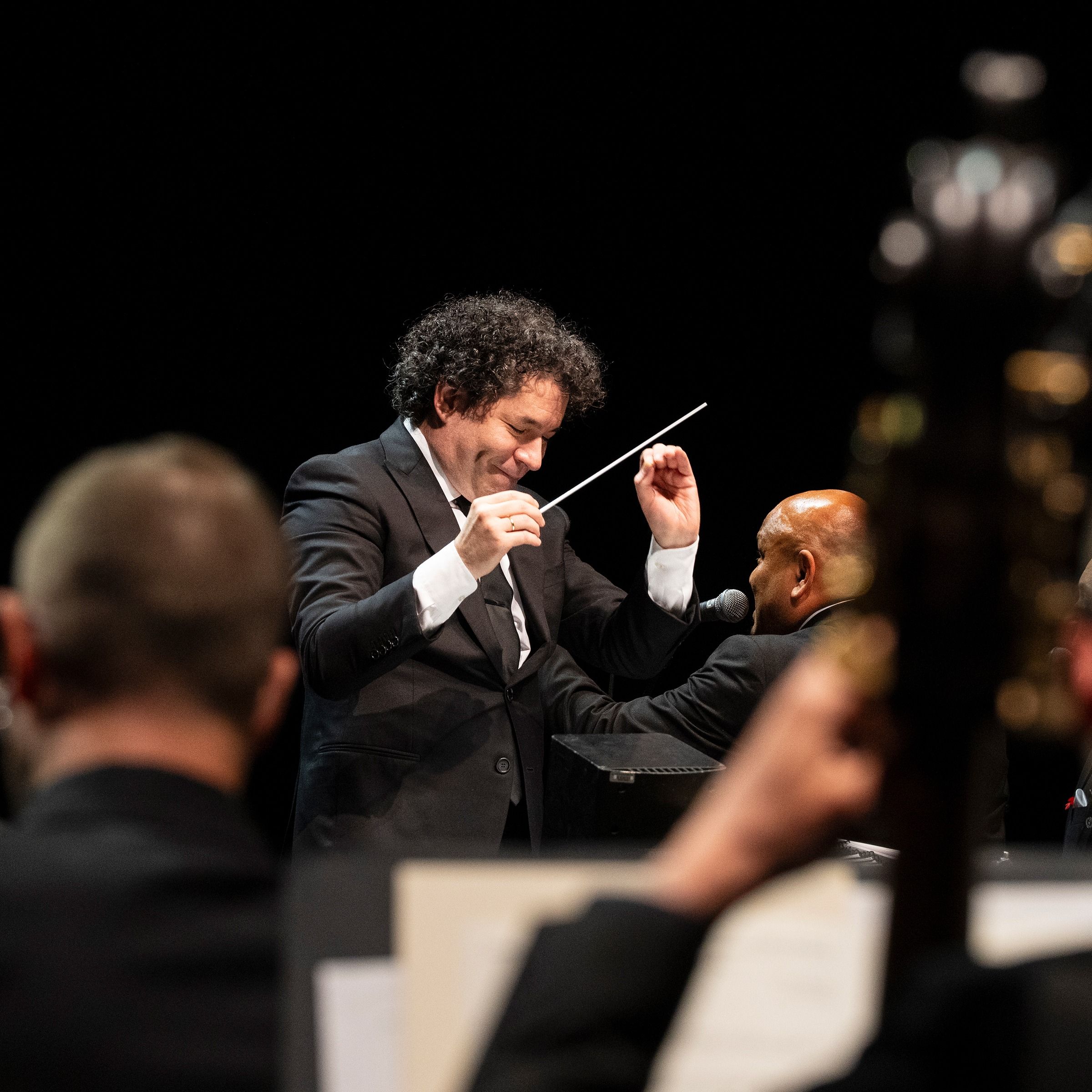
Classical Music Is in Crisis. Gustavo Dudamel Is Here to Save It.

🤖 AI Summary
Overview
This episode explores the transformative potential of Gustavo Dudamel, the celebrated Venezuelan conductor, as he takes the helm of the New York Philharmonic. It delves into his journey from a prodigy in Venezuela's El Sistema program to a global cultural icon, his success in revitalizing the Los Angeles Philharmonic, and the challenges and opportunities he faces in New York.
Notable Quotes
- Classical music is seen as elitist, but Dudamel is flattening the culture, saying there isn’t high art and low art—it’s all there for your enjoyment.
— Joshua Baroni, on Dudamel’s populist ethos.
- If you go to a New York Philharmonic concert and start to see less gray hair, that will be a huge success.
— Joshua Baroni, on the challenge of attracting younger audiences to classical music.
- Dudamel is not just conducting music; he’s conducting energy, channeling it between the orchestra and the audience.
— Joshua Baroni, on Dudamel’s dynamic style.
🎻 The State of Classical Music in Crisis
- Classical music in the U.S. has struggled with declining audiences, particularly among younger generations.
- Once a cultural mainstay, classical music has become a niche art form, with aging audiences and dwindling subscription models.
- The New York Philharmonic, the oldest orchestra in the U.S., has faced challenges with outdated venues, poor acoustics, and a lack of charismatic leadership since Leonard Bernstein’s era.
🌟 Gustavo Dudamel: The Rockstar Conductor
- Dudamel, a Venezuelan conductor, rose to fame through El Sistema, a revolutionary music education program that democratized access to classical music.
- By age 18, he was conducting Venezuela’s national youth orchestra, and by 23, he won the prestigious Gustav Mahler International Conducting Competition.
- His tenure at the Los Angeles Philharmonic transformed the orchestra into a cultural powerhouse, blending classical music with Hollywood and community outreach.
🎶 Revitalizing Classical Music in Los Angeles
- Dudamel founded the Youth Orchestra of Los Angeles (YOLA), bringing music education to underprivileged communities, particularly in Inglewood.
- He collaborated with Hollywood icons like Cate Blanchett and Anthony Hopkins, and worked on film scores with John Williams, bridging the gap between classical music and pop culture.
- Dudamel championed new music, commissioning works from contemporary composers like Gabriela Ortiz and John Adams, while also reinterpreting classical masterpieces with a fresh, dynamic style.
🏙️ The New York Philharmonic’s Gamble
- The New York Philharmonic’s president, Deborah Borda, pursued Dudamel for years, promising him resources to replicate his LA success, including community programs and innovative concert venues.
- Dudamel has already begun shaking up the Philharmonic’s programming, taking performances to unconventional venues like Radio City Music Hall and the United Palace Theater.
- His debut season includes collaborations with artists like Lizzo and a 9/11 memorial concert, signaling a commitment to making the Philharmonic more accessible and relevant.
🌍 The Future of Classical Music
- Dudamel’s mission is to prove that classical music can thrive in modern pop culture, much like Leonard Bernstein did in his time.
- His ability to attract diverse, younger audiences and bring classical music into mainstream spaces will be key indicators of his success.
- Dudamel’s approach—blending technical skill, emotional energy, and cultural inclusivity—positions him as a transformative figure in the world of classical music.
AI-generated content may not be accurate or complete and should not be relied upon as a sole source of truth.
📋 Episode Description
Music Featured (in order of appearance, all conducted by Gustavo Dudamel):
- Johann Strauss, Tik-Tak Polka, Polka Schnell, Op. 365, Weiner Philharmoniker (Sony Music Entertainment)
- Dmitri Shostakovich, Festive Overture, Op. 96, Simón Bolívar Youth Orchestra (Deutsche Grammophon)
- Gustav Mahler, Symphony No. 5 in C-Sharp Minor IV. Adagietto, Berlin Philharmonic (Berlin Philharmonic Recordings)
- Antonin Dvorak, Symphony No. 8 in G Major, Op. 88, B. 163, III. Allegretto grazioso- Molto vivace, Los Angeles Philharmonic (Deutsche Grammophon)
- John Williams, “The Imperial March” (From “Star Wars: Episode V — The Empire Strikes Back”), Los Angeles Philharmonic (UMG Recordings, Inc)
- John Adams, “En un Día de Amor Yo Bajé Hasta la Tierra,” The Gospel According to the Other Mary, Los Angeles Master Chorale and Los Angeles Philharmonic (Deutsche Grammophon)
- Gabriela Ortiz, “Kauyumari,” Los Angeles Philharmonic
- Ludwig Beethoven, Symphony No. 7 in A Major, Op. 92, IV. Allegro con brio, Simón Bolívar Youth Orchestra (Deutsche Grammophon)
- Thomas Adès, “XII. The Thieves — devoured by reptiles,” Dante, Los Angeles Master Chorale and Los Angeles Philharmonic (Nonesuch Records)
- Ludwig Beethoven, Symphony No. 5 in C Minor, Op. 67: I. Allegro con brio, Simón Bolívar Youth Orchestra (Deutsche Grammophon)
- Ludwig Beethoven, Symphony No. 5 in C Minor, Op. 67: I. Allegro con brio, Simón Bolívar Symphony Orchestra (self-released)
- Leonard Bernstein, “End Credits” and “The Dance at the Gym: Mambo,” from “West Side Story” (Original Motion Picture Soundtrack), Los Angeles Philharmonic and New York Philharmonic (Hollywood Records)
On Today’s Episode:
Joshua Barone is an editor for the Culture section of The New York Times who works on classical music and dance coverage. He also writes criticism about classical music and opera.
Background Reading:
- Gustavo Dudamel’s Long Goodbye to L.A., and Long Hello to New York
What Makes Superstar Conductor Gustavo Dudamel So Good?
Photo Credit: James Estrin/ The New York Times
For more information on today’s episode, visit nytimes.com/thedaily. Transcripts of each episode will be made available by the next workday.
Subscribe today at nytimes.com/podcasts or on Apple Podcasts and Spotify. You can