
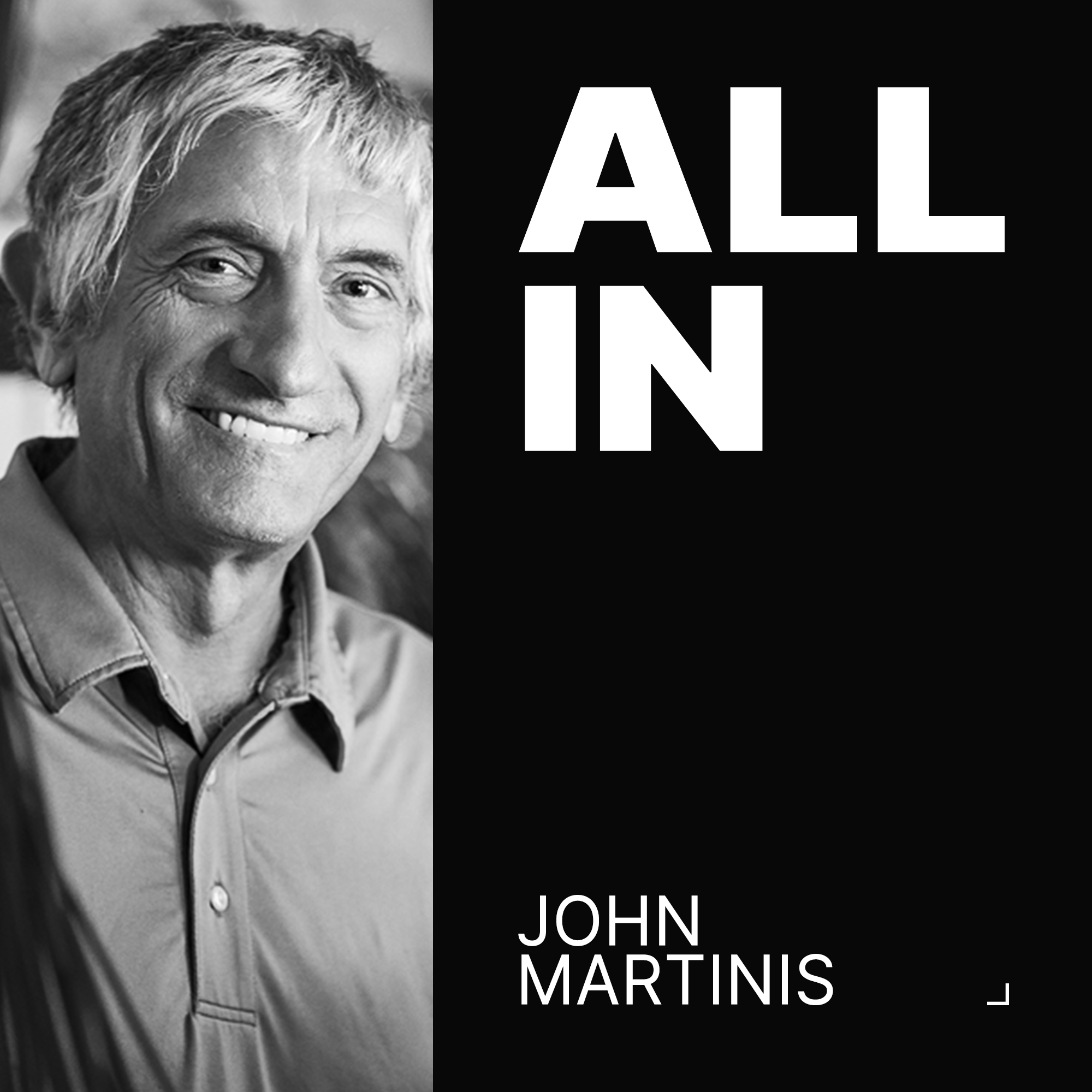
Nobel Prize in Physics Winner: John Martinis on the State of Quantum

🤖 AI Summary
Overview
This episode features an in-depth conversation with John Martinis, the 2025 Nobel Prize winner in Physics, exploring his groundbreaking work in quantum mechanics and quantum computing. The discussion spans his early inspirations, the pivotal experiments that led to his Nobel recognition, the current state of quantum computing, and the global race in quantum technology.
Notable Quotes
- The probability of all of my atoms being in the perfect position to cross through a wall is so low, it would never happen in this or many other universes.
– David Friedberg, on the improbability of macroscopic quantum tunneling.
- The secret of an important scientific breakthrough is: does it lead to other experiments, papers, and inventions?
– John Martinis, reflecting on the long-term impact of his work.
- Right now, we're at 100 qubits, but to solve really hard problems, we need a million.
– John Martinis, on the challenges of scaling quantum computing.
🧑🔬 Early Inspirations and Path to Physics
- John Martinis grew up in San Pedro, California, where his father, a fireman with no formal education, inspired his curiosity by building projects in their garage.
- His passion for physics began in high school, where he appreciated the mathematical and conceptual clarity of the subject.
- At UC Berkeley, he was introduced to quantum mechanics and electrical devices, setting the stage for his groundbreaking research.
🔍 Quantum Mechanics and Tunneling Explained
- Martinis and Friedberg delve into the fundamentals of quantum mechanics, emphasizing its non-intuitive nature and reliance on probabilities to describe particle behavior.
- A key focus is quantum tunneling, where particles can pass through barriers due to their wave-like properties—a phenomenon foundational to modern electronics.
- Martinis' 1985 experiment demonstrated quantum mechanics at a macroscopic scale using electrical circuits, a pivotal moment in the field.
💻 The Evolution of Quantum Computing
- Martinis explains the design of qubits, the building blocks of quantum computers, which leverage superconducting circuits to exhibit quantum behavior.
- His work at Google led to the 2019 quantum supremacy experiment, where a quantum computer outperformed classical systems on a specific task.
- Despite progress, quantum computers remain limited by noise and scalability, with practical applications still a decade away.
🌍 US vs. China in Quantum Technology
- Martinis acknowledges China's rapid advancements in quantum computing, noting their ability to replicate and compete with Western breakthroughs.
- He highlights the importance of leveraging advanced fabrication techniques and industrial partnerships to maintain a competitive edge.
🏆 Winning the Nobel Prize and Reflections
- Martinis shares the emotional journey of receiving the Nobel Prize, a recognition of decades of work that catalyzed an entire field.
- He emphasizes the collaborative nature of scientific progress, with thousands of researchers now building on his foundational experiments.
- Looking ahead, Martinis remains focused on advancing quantum computing while appreciating the broader impact of his work on science and technology.
AI-generated content may not be accurate or complete and should not be relied upon as a sole source of truth.
📋 Episode Description
(0:00) David Friedberg intros John Martinis, the 2025 recipient of the Nobel Prize in Physics
(0:43) John's history, how he got into physics
(4:54) Explainer on quantum mechanics
(22:57) Quantum tunneling and the 1985 paper that led to this Nobel Prize
(30:37) Understanding qubits, the state of quantum computing, and the impact of AI
(40:56) US vs China in quantum, reactions to winning the Nobel Prize
Learn more about the 2025 Nobel Prize in Physics:
https://www.nobelprize.org/prizes/physics/2025/summary
Follow the besties:
Follow on X:
Follow on Instagram:
https://www.instagram.com/theallinpod
Follow on TikTok:
https://www.tiktok.com/@theallinpod
Follow on LinkedIn:
https://www.linkedin.com/company/allinpod
Intro Music Credit:
Intro Video Credit: