
It May Be Impossible to Outcompete Factory Farming – Lewis Bollard

🤖 AI Summary
Overview
This episode explores the economics, politics, and ethics of factory farming with Lewis Bollard, Farm Animal Welfare Program Director at Open Philanthropy. The discussion covers the astonishing efficiency of factory farming, the challenges of alternative proteins, the potential of humane technologies, and the surprising political influence of the meat industry. It also highlights actionable interventions to reduce animal suffering and the outsized impact of philanthropic funding in this neglected area.
Notable Quotes
- We have literally genetically changed chickens in this Frankensteinian way to suffer as much as possible.
– Dwarkesh Patel, on the extreme optimization of factory farming.
- A dollar can do more than 10 years of a better, more humane life for an animal. That is stupendous.
– Dwarkesh Patel, on the cost-effectiveness of animal welfare interventions.
- We made a mistake as a movement, making this about personal diet. Large-scale change comes from government and corporate reform.
– Lewis Bollard, on shifting the focus of animal welfare advocacy.
🐔 The Efficiency—and Cruelty—of Factory Farming
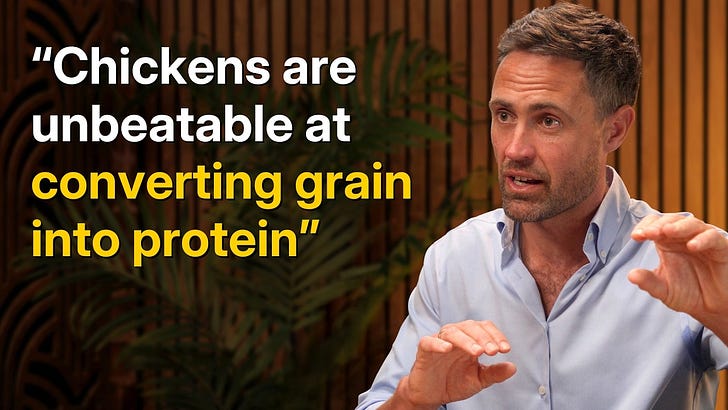
- Factory farming's efficiency stems from ruthless cost-cutting: chickens convert grain into protein at a 2:1 ratio, and animal welfare costs are eliminated. (Lewis Bollard)
- Technological progress has historically worsened animal suffering, with innovations like faster-growing chickens leading to severe health issues.
- The industry prioritizes efficiency over welfare, cramming more animals into smaller spaces, even if it increases mortality rates.
🧪 Humane Technologies and Alternative Proteins
- Technologies like inovo sexing (preventing the hatching of male chicks) have already spared 200 million chicks annually.
- Cultivated meat faces significant hurdles: scaling production and reducing costs to compete with factory-farmed chicken. (Lewis Bollard)
- Incremental reforms, such as breeding higher-welfare chickens with better health outcomes, are more achievable in the near term.
💰 The Astonishing Cost-Effectiveness of Animal Welfare Advocacy
- Less than $300 million is spent globally on factory farming reform, with $200 million going to evidence-based interventions.
- Corporate campaigns have driven significant progress: 47% of U.S. eggs are now cage-free, up from 10%, sparing 200 million hens annually.
- A dollar spent on effective advocacy can avert 10 years of animal suffering, making this one of the most impactful philanthropic opportunities.
🏛️ The Meat Lobby’s Surprising Political Power
- The meat industry spends $45 million per election cycle, leveraging its influence to block animal welfare reforms.
- Structural advantages, such as control over agriculture committees, allow the industry to stifle legislation despite overwhelming public support for reforms.
- Advocates have countered this by passing state-level ballot measures and pressuring corporations directly.
🌍 Global Trends and Opportunities
- In developing countries like China, rising meat consumption poses challenges, but there’s potential for alternative proteins to gain traction without entrenched industry resistance.
- Multinational corporations are beginning to adopt global animal welfare standards, creating opportunities to spread reforms internationally.
- Wealthier nations like Germany are starting to reduce total animal suffering, but advocacy is critical to mobilize public opinion and drive policy changes.
AI-generated content may not be accurate or complete and should not be relied upon as a sole source of truth.
📋 Episode Description
A deep dive with Lewis Bollard, who leads Open Philanthropy’s strategy for Farm Animal Welfare, on the surprising economics of the meat industry.
Why is factory farming so efficient? How can we make the lives of the 23+ billion animals living on factory farms more bearable? How far off are the moonshots (e.g., brainless chickens, cultivated meats, etc.) to end this mass suffering? And why does the meat industry have such a surprising amount of political influence?
For decades, innovation in the meat industry has actually made the conditions for animals worse. Can the next few decades of tech reverse this pattern?
Watch on YouTube; listen on Apple Podcasts or Spotify.
Donation match fundraiser
The welfare of animals on factory farms is so systemically neglected that just $1 can help avert 10 years of animal suffering.
After learning more about the outsized opportunities to help, I decided to give $250,000 as a donation match to farmkind.giving/dwarkesh. FarmKind directs your contributions to the most effective charities in this area.
Please consider contributing, even if it’s a small amount. Together, we can double each other's impact and give a total of $500,000.
Bluntly, there are some listeners who are in a position to give much more. Given how neglected this topic is, one such person could singlehandedly change the game for 10s of billions of animals. If you’re considering donating $50k or more, please reach out directly to Lewis and his team by emailing [email protected].
Timestamps
(00:00:00) – The astonishing efficiency of factory farming
(00:07:18) – It was a mistake making this about diet
(00:09:54) – Tech that’s sparing 100s of millions of animals/year
(00:16:16) – Brainless chickens and higher welfare breeds
(00:28:21) – $1 can prevent 10 years of animal suffering
(00:37:26) – Situation in China and the developing world
(00:41:41) – How the meat lobby got a lock on Congress
(00:53:23) – Business structure of the meat industry
(00:57:42) – Corporate campaigns are underrated
Get full access to Dwarkesh Podcast at www.dwarkesh.com/subscribe