
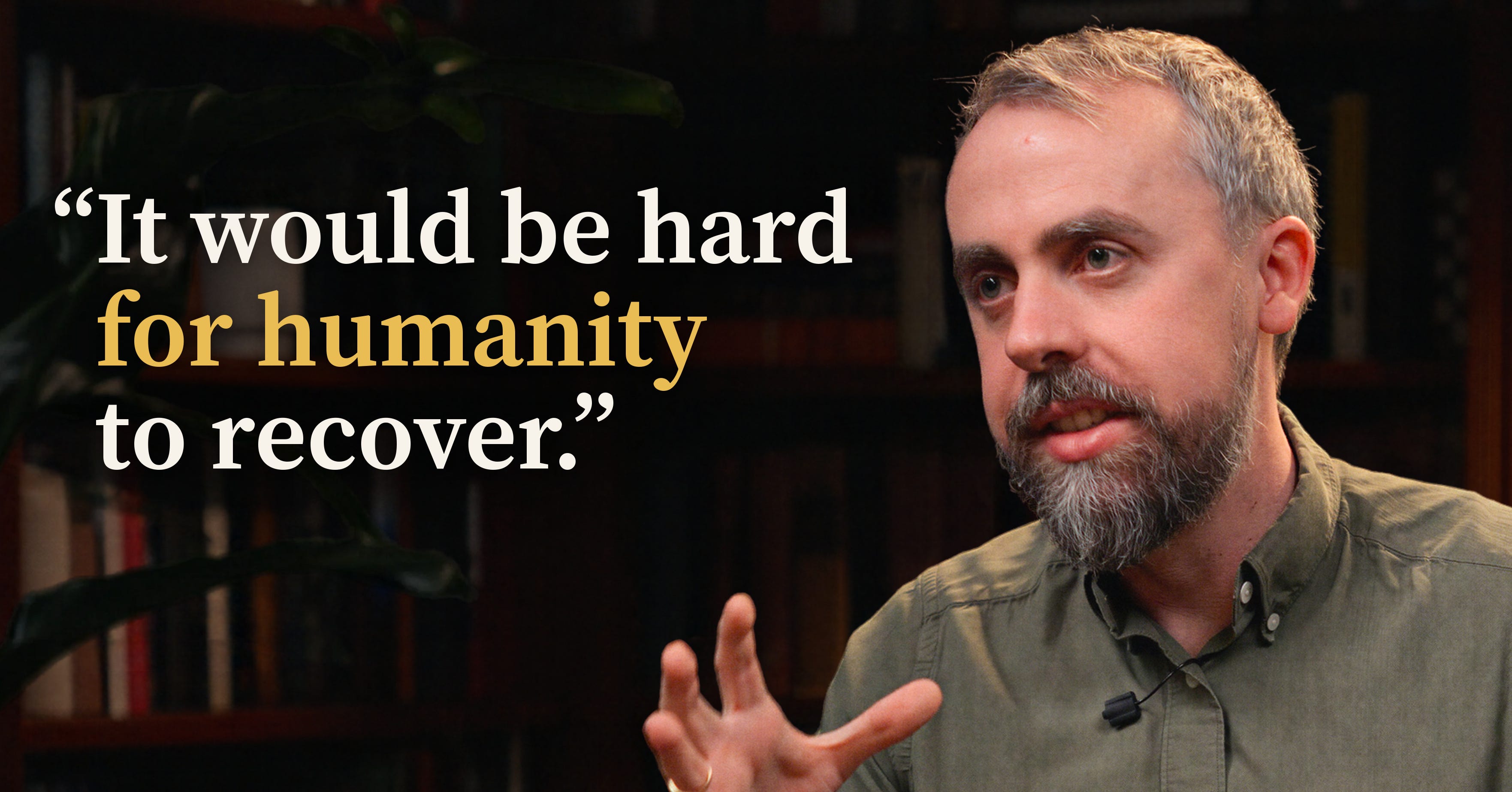
Paul Christiano – We could be 12 months away from AIs that can overthrow the government

🤖 AI Summary
Overview
Paul Christiano, head of the Alignment Research Center and former leader of AI safety at OpenAI, discusses the urgent risks posed by rapidly advancing AI capabilities. He estimates a 1 in 3 chance that superintelligent AI capable of overthrowing governments could emerge within a year if current development trajectories continue unchecked. He advocates for a pause in algorithmic progress to address security vulnerabilities and alignment challenges, emphasizing the need for better governance and transparency. Christiano also outlines the challenges of controlling superintelligence and the precarious reliance on AI itself to solve alignment problems.
Notable Quotes
- There is a reasonable chance that in a year we will produce AI systems much better than humans at almost everything, where humans would have very little chance of competing with them or controlling them.
— Paul Christiano, on the urgency of the AI trajectory.
- If we do not slow down, we may end up in a world where six months from now there is a disaster that kills very large numbers of people or where the government is overthrown.
— Paul Christiano, on the risks of rapid AI development.
- The hope is that the AIs figure out the solution to alignment during the intelligence explosion.
— Paul Christiano, on the precarious reliance on AI to solve its own control problem.
🧠 The Imminent Risk of Superintelligence
- Christiano estimates a 10% chance of AI disempowering humanity within 6-12 months and a 33% chance of superintelligence emerging within a year if development continues at its current pace.
- He warns of a rapid intelligence explosion
where AI systems become uncontrollable, potentially leading to catastrophic outcomes such as government overthrows or mass casualties.
- Security vulnerabilities in AI labs, such as the risk of model or algorithm theft by adversaries, exacerbate the danger. Christiano cites recent breaches at OpenAI and Anthropic as evidence of inadequate cybersecurity.
🚀 Accelerating AI Development and Recursive Self-Improvement
- Christiano highlights the risk of AI automating its own development, leading to recursive self-improvement and exponential acceleration in capabilities.
- He notes that tasks previously requiring years of human effort could be compressed into months or weeks due to AI-driven automation in research and development.
- Recent advancements in AI performance on tasks like math and computer science suggest that AI could soon surpass human capabilities across a wide range of domains.
🔒 The Case for Pausing Algorithmic Progress
- Christiano argues that AI labs should pause further algorithmic advancements until they can secure their research and models against theft and misuse.
- He emphasizes that without robust security, adversaries could steal AI models and use them recklessly, forcing labs to continue racing forward even if they recognize the risks.
- He also calls for greater transparency and public discussion about AI capabilities and alignment challenges to build a shared understanding of the risks.
🛠️ Alignment Challenges and the Hope for AI Solutions
- Current alignment methods, such as fixing reward hacks and improving training environments, are unlikely to scale to superintelligence.
- Christiano acknowledges that no single approach has better than even odds of success in controlling superintelligence.
- The prevailing hope is that AI itself will help solve alignment problems during the intelligence explosion, though this is a high-stakes gamble.
🌍 The Broader Implications of AI Governance
- Christiano stresses the need for global coordination to manage AI risks, particularly to prevent adversarial nations from exploiting stolen AI capabilities.
- He warns that without a shared governance framework, unilateral pauses by one lab could be undermined by others, leading to a dangerous race dynamic.
- He advocates for urgent discussions among policymakers, scientists, and AI developers to establish norms and safeguards before it’s too late.
AI-generated content may not be accurate or complete and should not be relied upon as a sole source of truth.
📋 Episode Description
Paul Christiano is head of the Alignment Research Center. Previously, he was head of AI safety at the US AI Safety Institute. Before that, he led alignment at OpenAI, where he invented RLHF. He’s recently joined OpenAI’s board (though here he is speaking as a private citizen).
Paul thinks that on the current trajectory (absent any slowing down), there is a 1 in 3 chance that we could have superintelligence powerful enough to overthrow the government within a year. (He articulates a concrete scenario).
He argues that the labs should pause further algorithmic progress until they can secure their weights and research secrets. Otherwise China could simply steal the superintelligence in the middle of the intelligence explosion, and the labs would no longer be able to slow down even if they saw their models going off the rails.
He also explains how AIs will be trained during the intelligence explosion, and why even a system trained entirely inside a data center could still have the capabilities profile such that humans would have very little chance of competing with it or controlling it.
And he discusses the plan for alignment - basically, making a superintelligence that actually does what we ask the way we mean it. Fixing reward hacks and building better graders will help up till the next few model generations, but he thinks that no single current approach has better than even odds of letting us control superintelligence. The hope is that the AIs figure out the solution to this problem during the intelligence explosion.
Watch on YouTube; read the transcript.
Sponsors
* Jane Street has finally come around on formal methods. Ron Minsky, who co-heads Jane Street’s technology group, told me that up until recently, formal methods just weren’t worth the cost. But coding agents have made them easier to apply AND increased the importance of code verification. So now Jane Street is hiring Formal Methods Engineers in both their London and New York offices. If you’re interested, or if you want to watch my full conversation with Ron, go to janestreet.com/dwarkesh
* Antithesis is NOT another LLM-based code-review tool. It doesn’t try to reason abstractly about how a PR might break your system. Instead, it just runs your code. You start by defining the rules that your system must never break. Then, whenever an agent proposes a change, Antithesis runs your code through thousands of adversarial worlds, testing whether or not it still adheres to your rules. If you want to try it, go to ant