
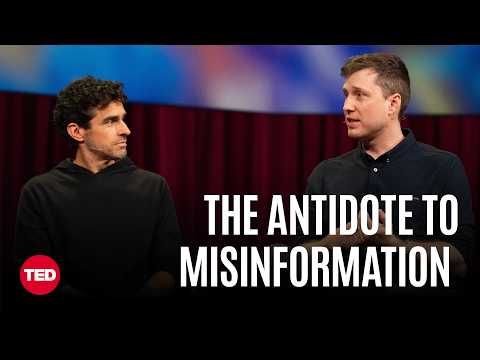
How Community Notes Reduce Viral Misinformation | Keith Coleman, Jay Baxter | TED

🤖 AI Summary
Overview
This discussion explores the development and impact of Community Notes, a crowdsourced fact-checking system on X (formerly Twitter). Keith Coleman and Jay Baxter detail how the platform combats misinformation, fosters trust across political divides, and leverages AI-human collaboration to scale its effectiveness. They also envision a future where social media promotes common ground rather than division.
Notable Quotes
- A random person on the internet wrote a note, and suddenly, leaders of the free world changed their public statement. That’s like a superpower for people.
– Keith Coleman, on the power of Community Notes.
- Our algorithm takes advantage of partisanship and polarization to ensure notes are fact-checked from every angle, resulting in highly accurate and neutral content.
– Jay Baxter, on the surprising agreement mechanism.
- If all we did was pursue the areas of agreement, I think people would be pretty happy with the direction the world was going.
– Keith Coleman, on the potential of identifying common ground at scale.
🛠️ The Mechanics of Community Notes
- Community Notes allow users to add context to misleading or incomplete posts, including those from heads of state or official accounts.
- Notes are only displayed if rated helpful by users with differing perspectives, ensuring neutrality and trust.
- The system is open-source, allowing anyone to verify the algorithm and data, which fosters transparency.
- Unlike traditional fact-checking, which can take days, Community Notes often appear within hours, sometimes as quickly as 20 minutes.
📊 Leveraging Polarization for Accuracy
- The surprising agreement
algorithm identifies notes that are rated helpful by users with opposing political views.
- Polarization is used as a feature, not a bug: people with strong opposing views are more likely to rigorously fact-check notes, leading to higher accuracy.
- Notes that fail to meet quality standards or are overly biased result in contributors losing their ability to write notes.
🤖 AI-Human Collaboration
- AI is integrated into the system to draft initial notes, which are then refined by human contributors.
- Human feedback on AI-generated notes serves as training data, improving the AI’s ability to produce accurate, neutral, and well-sourced content.
- This collaboration accelerates the speed of note creation while maintaining quality.
📉 Impact on Misinformation and Behavior
- Posts flagged with Community Notes see a 50% drop in reposts and engagement, driven by organic user behavior rather than algorithmic downranking.
- Authors of flagged posts are more likely to delete their content, reducing the spread of misinformation.
- The system has proven effective across diverse topics, from AI-generated war imagery to political claims, demonstrating its scalability.
🌍 Building a Pro-Social Media Future
- A pilot program highlights posts liked by people with differing perspectives, encouraging constructive dialogue and reducing polarization.
- The team envisions applying this approach beyond social media, such as in policymaking, to focus on areas of agreement and foster societal progress.
- By identifying and amplifying common ground, the system aims to transform social media into a tool for unity rather than division.
AI-generated content may not be accurate or complete and should not be relied upon as a sole source of truth.
📋 Video Description
Community Notes on X started with a wild idea: Instead of tech companies deciding what's true, what if you let people fact-check each other? Jay Baxter and Keith Coleman, who helped build the crowdsourced system adding context to misleading posts, discuss how the program reduces viral misinformation — and why people across the political spectrum trust it. In conversation with TED guest curator Audrey Tang, they discuss how their "surprising agreement" algorithm could reveal the common ground that quietly exists across a polarized internet. (Followed by a note from TED guest curators Divya Siddarth and Audrey Tang) (Recorded at TED2026 on April 14, 2026)
Join us in person at a TED conference: https://tedtalks.social/events
Become a TED Member to support our mission: https://ted.com/membership
Subscribe to a TED newsletter: https://ted.com/newsletters
Follow TED!
Instagram: https://www.instagram.com/ted
LinkedIn: https://www.linkedin.com/company/ted-conferences
TikTok: https://www.tiktok.com/@tedtoks
Facebook: https://facebook.com/TED
X: https://www.twitter.com/TEDTalks
The TED Talks channel features the best talks and performances from the TED Conference, where the world's leading thinkers and doers give the talk of their lives in 18 minutes (or less) — plus originals, podcasts and exclusive content. Look for videos on Technology, Entertainment and Design as well as science, business, global issues, the arts and more. Visit https://TED.com for our entire library, transcripts, translations and personalized recommendations.
Watch more: https://go.ted.com/baxtercoleman
https://youtu.be/W23KEEcFqTk
TED videos may be used for non-commercial purposes under a Creative Commons License, Attribution–Non Commercial–No Derivatives (or the CC BY – NC – ND 4.0 International) and in accordance with the TED Talks Usage Policy: https://www.ted.com/about/our-organization/our-policies-terms/ted-talks-usage-policy. For more information on using TED for commercial purposes (e.g. employee learning, in a film or online course), submit a request at https://media-requests.ted.com
#TED #TEDTalks #Technology #X